Residential Real Estate News

Baby Boomers Tighten Grip on Large Home Ownership
Squeezing Younger Families Out of the Market
According to Redfin, baby boomers are retaining a disproportionate share of America's largest homes, deepening a generational imbalance that is constraining mobility for younger families and reshaping the dynamics of the U.S. housing market.
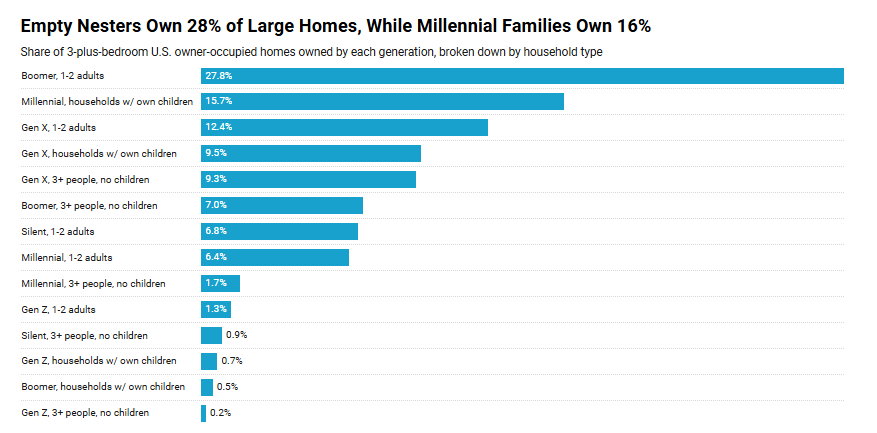
Roughly 28% of the nation's three-bedroom-plus homes are owned by baby boomers living in one- or two-adult households, according to new data from Redfin. Millennials with children--despite representing the largest cohort of parents in the U.S.--control just 16% of that housing stock. For Gen Z parents, ownership barely registers, accounting for less than 1%.
An additional 7% of large homes are held by boomers in multi-adult households, often reflecting adult children living at home, further limiting turnover in a segment critical for growing families.
A Structural Bottleneck Emerges
The imbalance highlights a structural bottleneck: older homeowners are aging in place while younger families struggle to "trade up" into larger properties. The result is a market with limited supply where it is needed most.
Two forces are reinforcing the gridlock. First, there is a shortage of smaller, affordable homes that would enable older Americans to downsize. Second, elevated home prices and mortgage rates continue to price out younger buyers attempting to enter or move up the housing ladder.
More than a quarter of millennials say they are delaying a home purchase due to high borrowing costs, according to a late-2025 survey conducted by Ipsos for Redfin. Another 20% cite difficulty saving for a down payment, while a smaller share point to lifestyle preferences, including flexibility and reduced maintenance responsibilities.
Low Incentives to Move
For many boomers, the financial calculus favors staying put. Nearly 58% of homeowners in that generation have fully paid off their mortgages, insulating them from rising interest rates and reducing the urgency to relocate. Others remain anchored by community ties, proximity to family, and familiarity with long-established neighborhoods.
"Even when older homeowners express interest in downsizing, the options often don't align with what they want--or what they're willing to pay," said a Redfin Premier agent in Philadelphia. "That lack of viable alternatives keeps inventory locked up and limits opportunities for younger buyers."
Early Signs of Thaw
There are tentative indications the stalemate may begin to ease. Housing affordability has shown early signs of improvement, and a gradual loosening of the so-called mortgage-rate lock-in effect could encourage more listings over time.
Agents in several markets report an uptick in downsizing activity among older homeowners, particularly those seeking lower-maintenance properties. Still, such listings remain sporadic and highly competitive.
Redfin also points to new marketing strategies--developed in partnership with Compass--that allow sellers to test pricing before formally listing, a move economists estimate could lift housing inventory by 6% to 12% annually in participating markets.
Generational Shift, Slowly Underway
Over the past decade, millennials have increased their foothold in the large-home segment, with their share rising from roughly 5% in 2014 to nearly 16% today. Much of that gain, however, reflects a generational handoff from the Silent Generation, whose ownership share has dropped sharply, rather than a broad-based release of supply from baby boomers.
Meanwhile, the median age of first-time homebuyers has edged down in recent years, and homeownership rates among Gen Z and millennials have begun to tick higher--signs that some inventory is gradually turning over.
Regional Disparities Persist
The generational divide is evident across major metropolitan areas. Millennials with children command their largest share of big homes in faster-growing, relatively affordable markets such as Austin and Columbus, where they account for roughly one-fifth of large-home ownership. Their presence is weakest in high-cost coastal hubs like Los Angeles, where they hold just over 10%.
Baby boomers, by contrast, dominate large-home ownership in nearly every major metro area, with particularly high concentrations in markets such as Memphis, Cleveland, and Pittsburgh.
A Market Defined by Inertia
For now, the U.S. housing market remains characterized by inertia: older homeowners holding onto space they no longer need, and younger families unable to access it.
Until either affordability improves materially or downsizing becomes more viable at scale, the imbalance is likely to persist--leaving one of the most sought-after segments of the housing market effectively frozen between generations.